

Delivering integrated monitoring for 24/7 operational continuity
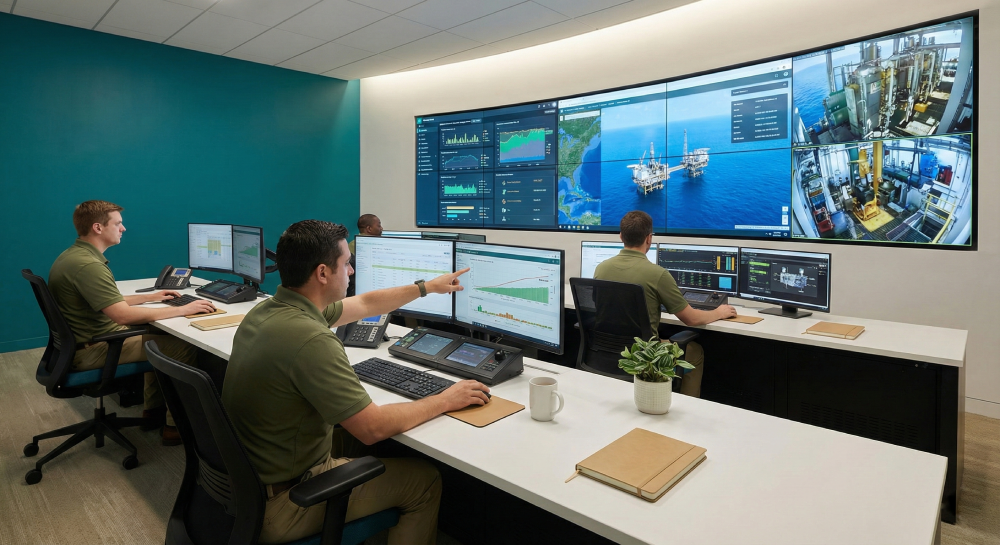
Optimizing complex, high-risk environments. For energy, oil & gas, and industrial operators, we deliver systems that support operational continuity, safety, and performance at scale.
Background
A major oil & gas operator with production facilities across multiple offshore and onshore locations faced challenges coordinating real-time operations data. Their legacy SCADA systems and separate databases made it difficult to achieve unified visibility across all assets. Production sites operated independently with limited coordination, causing inefficiencies in resource allocation and maintenance scheduling across the enterprise.
Safety incidents increased due to delayed maintenance response times and lack of real-time equipment status visibility. Equipment failures were not detected quickly, resulting in unplanned shutdowns and safety risks. Maintenance planning relied on historical data rather than real-time asset condition monitoring. Regulatory compliance reporting was time-consuming and manual, increasing audit risk. Emergency response coordination was inefficient due to lack of integrated communication systems.
The Solution
We implemented an Integrated Operations Center (IOC) platform that consolidated real-time data from all production sites and remote assets. This unified monitoring system provided immediate visibility into asset status, environmental conditions, and equipment performance across the entire operation. Real-time alerting enabled proactive maintenance scheduling and emergency response coordination.
Advanced sensor networks were deployed at all production sites and remote locations to capture real-time operational metrics. These sensors monitor equipment vibration, temperature, pressure, and fluid analysis – enabling predictive maintenance and early failure detection.
AI-powered analytics engine processes real-time data to identify patterns, anomalies, and potential issues before they impact operations. Machine learning models predict equipment failures weeks in advance, allowing scheduled maintenance rather than emergency repairs.
Mobile and web applications were developed for field personnel, providing access to real-time asset status, maintenance schedules, and emergency procedures from any location. Integrated communication systems enable instant coordination between control centers, production sites, and field teams across time zones.
Comprehensive operator training programs ensured staff could effectively use the new system and respond to alerts appropriately. Safety drills were conducted regularly to verify emergency procedures worked as designed. System validation confirmed reliability and accuracy of all measurements before full operational deployment across all assets.
The Challenges
Deploying integrated systems across geographically dispersed offshore and onshore locations presented significant challenges. Network connectivity to remote platforms was limited. System integration had to accommodate existing equipment with varying communication protocols. Implementation had to maintain 24/7 operational continuity – any disruption could impact safety and production revenue significantly.
We employed a phased deployment strategy, first deploying sensors and monitoring at non-critical locations to validate system performance. Redundant communication paths and backup systems ensured connectivity was never lost. Real-time data feeds were routed through multiple networks to guarantee service availability even if primary communication channels failed.
Extensive safety testing and hazard analysis were conducted before deployment. All potential failure modes were reviewed and mitigated. Integration testing confirmed the system responded correctly to equipment faults and emergencies. Regulatory compliance was verified for all operational and safety requirements across jurisdictions.
The investment in proper systems and integration delivered significant return on investment. Prevented equipment failures avoided emergency shutdowns worth millions in lost production. Optimized maintenance scheduling reduced spare parts inventory and logistics costs. Enhanced operational visibility reduced fuel and energy waste across all assets. Safety improvements reduced incident-related costs and regulatory penalties.
The Result
Unplanned shutdowns reduced by 89% through predictive maintenance capabilities. Asset utilization improved significantly as equipment runs at optimal efficiency with less idle time. Equipment lifetime extended through proactive maintenance rather than reactive repairs. Production uptime increased to 99.7%, approaching theoretical maximum across all operations.
The integrated monitoring system has transformed how we manage operations. Real-time visibility across all assets eliminates guesswork from maintenance planning. We can now predict and prevent equipment failures rather than reacting to emergencies. Safety has improved dramatically through early detection and faster emergency response. The operational visibility we now have is invaluable for strategic planning.
VP Operations & Chief Safety Officer, Global Energy Operations
Operational costs decreased 28% through optimized energy consumption and reduced emergency response expenses. Maintenance costs reduced by 43% through predictive scheduling. Inventory carrying costs decreased due to better maintenance planning. Overall operating margin improved significantly – the system essentially paid for itself within 2.5 years through cost avoidance alone.
All production sites – offshore platforms, onshore facilities, and remote installations – have uniform access to monitoring and communication systems. No central dependency exists; if any single location loses connectivity, all others continue operating normally. Field operators can access all necessary information from mobile devices, making emergency response faster and more coordinated. Remote operations management became feasible from control centers thousands of miles away.
Safety record improved dramatically with 95% reduction in safety incidents. Predictive monitoring prevents equipment failures that could lead to catastrophic events. Automated emergency response procedures reduce human error during critical situations. Regulatory compliance is now continuous rather than periodic, ensuring the operation maintains perfect safety standing at all times.